How to calculate a Product Carbon Footprint
Regulators, customers, and investors are increasingly asking one question: what are the emissions of your product, not just your operations?

A product carbon footprint (PCF) measures the total greenhouse gas emissions generated across a product’s lifecycle, from raw material extraction through manufacturing, transport, use, and end of life. It is expressed in kilograms of CO₂ equivalent (kg CO₂e) relative to a defined functional or declared unit of the product.
For sustainability managers already tracking scope 3 emissions, the data foundation for PCF work is often closer than you would expect. Product-level carbon reporting is moving from voluntary to required across several regulatory frameworks. The EU Battery Regulation mandates carbon footprint declarations from 2026. The Carbon Border Adjustment Mechanism (CBAM) requires importers of steel, aluminium, cement, and other goods to report the embedded carbon of their products. The Ecodesign for Sustainable Products Regulation (ESPR) will introduce Digital Product Passports that include PCF data for a growing list of product categories from 2026 onwards. Beyond regulation, large companies with their own scope 3 commitments are increasingly asking their suppliers for product-level emissions data directly.
Companies that build the capability now will be significantly better placed when reporting becomes mandatory for their sector.
What goes into a product carbon footprint
A PCF covers emissions across a product’s full lifecycle, typically broken into stages:
- Raw materials: extraction and processing of inputs
- Manufacturing: energy used in production
- Transport: moving materials and finished goods
- Use phase: emissions during product use (relevant for energy-consuming products)
- End of life: disposal, recycling, or decomposition
In practice, most companies start with a cradle-to-gate scope, covering raw material extraction through to the point of sale. This is also the scope defined by the PACT Framework, making it the most widely used approach for producing comparable, supply-chain-ready PCF data.
Simply put, each emission is calculated by multiplying a quantity (a material, a process, a transport leg) by its relevant emission factor. The sum across all stages is your PCF.
What data you need to get started
The main input is a bill of materials (BOM): the list of components and materials that make up your product, including quantities and, ideally, supplier or origin information.
From your BOM, you will match each material or component to an emission factor. Emission factors are coefficients that translate a quantity of material, energy, or activity into a CO₂ equivalent figure. They come from databases like ecoinvent, the UK Government’s GHG conversion factors, or industry-specific sources.
You will also need:
- Manufacturing energy data: electricity and fuel consumed in your own production
- Supplier processing and transformation: emissions from processing raw materials before they reach you (e.g. smelting, refining, chemical transformation)
- Transport data: distance and mode for key logistics legs
- Use phase data: if your product consumes energy during use
- End-of-life assumptions: waste treatment method and location
The quality of your PCF depends directly on the quality of this data. Spend-based data can get you started, but the PACT Pathfinder Framework recommends primary activity-based data (real quantities matched to specific emission factors) as the standard for comparable, credible results. If your team is already collecting supplier-specific data for scope 3 reporting, much of that groundwork carries over directly.
How the calculation works
Once your data is assembled, the calculation follows a consistent process:
- Map your BOM to emission factors: match each line item to the most appropriate emission factor, noting the data source and any assumptions made
- Calculate emissions per component: quantity multiplied by emission factor equals kg CO₂e
- Sum across all lifecycle stages: add up contributions from materials, manufacturing, transport, and use
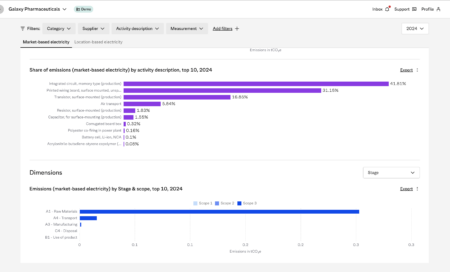
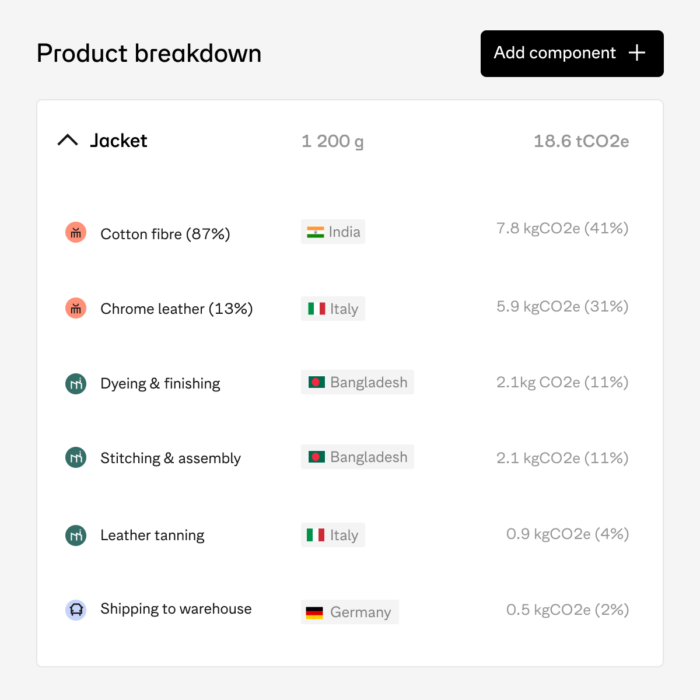
- Identify hotspots: which components or stages account for the largest share of emissions
- Document your methodology: scope used, which databases, and any assumptions
Done manually in a spreadsheet, this process is feasible for products with simple BOMs. For products with hundreds of components, multiple manufacturing sites, or complex supply chains, the mapping work becomes substantial.
This is where purpose-built tooling makes a difference. Normative’s PCF tool handles bulk ingestion of BOM data, matches components to emission factors at scale, and surfaces the hotspots that matter most. For teams that want expert support alongside the tool, Normative also offers a managed PCF service with guidance from data collection through to final results.
What to do with your PCF results
A PCF is most useful when it drives action. Once you have results:
Report and share: for regulatory submissions (EU Battery Regulation, CBAM, ESRS, ESPR), customer and investor disclosure, and product marketing such as eco-labels. For further context:
- EU Battery Regulation: PCFs are explicitly required for certain battery categories.
- ESPR: Whether a PCF is actually required depends on your product category and rules still being written, but for many, it will be needed.
- Eco-labels: Depending on the eco-label schemes, a PCF is a requested element.
- CBAM: CBAM requires embedded carbon reporting but uses its own specific methodology. A standard PCF may not be directly usable for CBAM submissions without adjustments.
- ESRS: ESRS may require you to disclose how you manage product emissions, but it doesn’t take PCF submissions directly. Having a PCF will help with that disclosure category.
Compare across products: identify which product lines carry the highest footprint and prioritize accordingly
Inform design decisions: use hotspot analysis to guide material substitutions or supplier changes before designs are locked
Track reductions over time: recalculate as you make changes to verify that interventions are working
The earlier in the product lifecycle you calculate, the more options you have to act. A PCF completed after launch tells you where you stand. One completed during design tells you what to change.
Getting to your first result
Calculating a product carbon footprint is a defined, repeatable process, and one that is increasingly expected of companies operating in regulated markets or responding to customer and investor demand.
If you are already managing scope 1, 2, and 3 emissions in a carbon accounting platform, you do not need to buy a separate PCF tool to get started. Normative’s PCF capability is built into the same platform, so your existing data, your team, and your reporting workflows all carry over.
Need help with your PCFs?
Find out more about how Normative’s PCF tool and GHGP-certified climate strategists can help your business master PCFs.