Reduce carbon accounting time to value with Categorization Memory
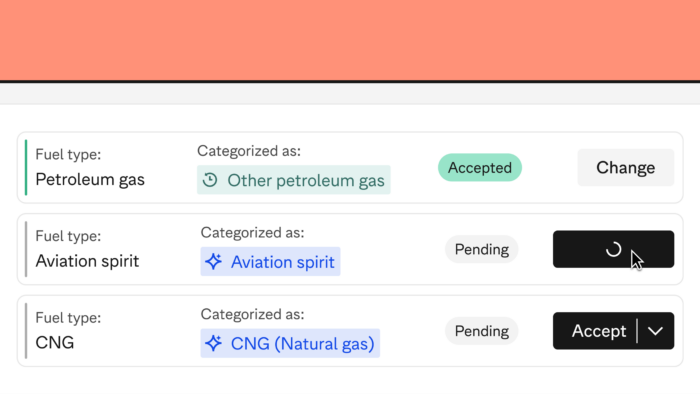
Deliver consistency across carbon emissions reporting cycles. Find out how, with Categorization Memory.

Why is emissions data categorization challenging for businesses
552 hours a year is spent by office workers doing repetitive or administrative tasks.
Nowhere is this drain on productivity better emphasized than in carbon accounting. Reporting cycles are annual, datasets change, and there aren’t many tools that support consistent categorization of emissions data year-on-year. The result? Countless hours are committed to repetitive work, classification of data is inconsistent from year to year and, ultimately, the path from data collection to insights is much slower.
It is this burden on businesses that has prompted us to introduce a new feature to Normative’s carbon management platform. Categorization Memory changes the game for these businesses, turning carbon accounting from a repetitive, manual process into one that gets faster, more consistent, and more reliable with every use.
This article will drill down into how smart categorization can make a difference to your business, and how Normative’s platform can solve the pervading challenges.
What can Normative’s Categorization Memory feature deliver for your business
Categorization memory automatically reuses categorizations that have been accepted in previous data uploads. So, when these same descriptive labels appear again, Normatively immediately applies the same categorization and auto-accepts it.
What does this mean?
Not only can businesses eliminate repetitive work, crucially they can also ensure consistent results from one reporting cycle to another. This latter point is an essential part of making carbon emissions reporting audit-ready, something that isn’t easy as more and more people are involved in inputting emissions data, all with differing levels of expertise and formatting.
How does it work?
Normative recognizes recurring data using combinations of user input.
- An exact match is delivered if these fields are the same as previous uploads. The system then performs this match and automatically applies the same categorization.
- A partial match will be proposed for review if only some fields match.
- A new categorization suggestion is put forward by the system, powered by a Large Language Model (LLM) if no prior match exists. Future iterations will include reasoning and confidence levels.
Automation and AI balanced with user control
Throughout the development process, we’ve made sure that businesses can benefit from the productivity and consistency gains that automation and AI drives in this instance, without sacrificing data quality.
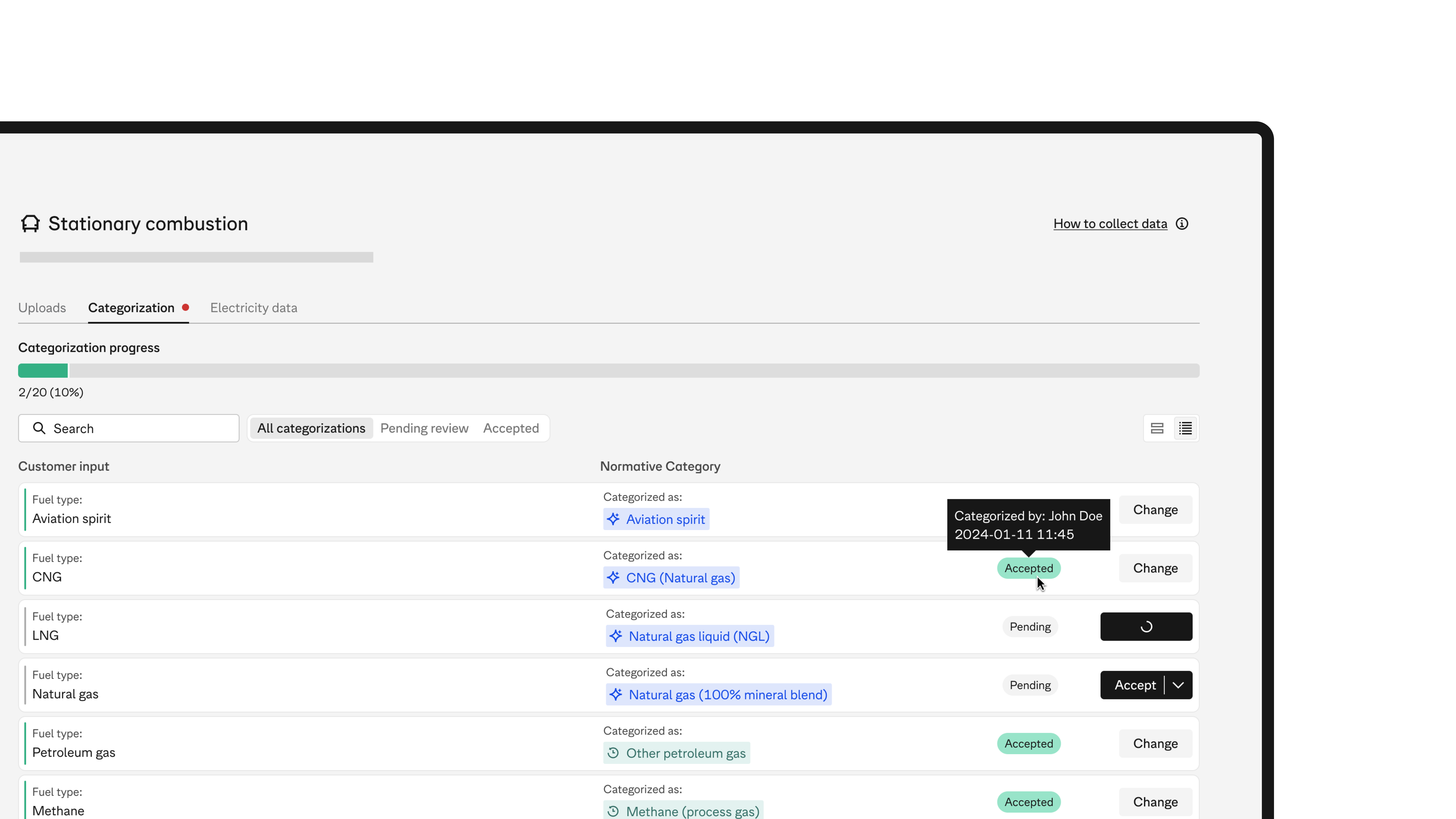
Every categorization across scopes 1, 2, and 3, whether it is an exact match, partial match or an AI-powered new categorization suggestion, will be clearly labelled in the categorization view where the user can review, accept or recategorize their data. After this users can bulk edit, filter, and recategorize more granular data via the grid view, retaining the element of user control. On top of this, all uploaded data still goes through Normative’s QA (Quality Assurance) process to make sure it is accurate, complete and compliant with the GHG Protocol.
Categorization view is also a great way to identify which suggestions came from the memory, and which were proposed by the LLM-supported prediction service. So not only can users edit and refine where required, they can also ensure that the process is fully transparent.
This human element of control over QA is an essential part of why Normative’s offering is unique. Where many similar offerings are ‘AI-only’, Normative stands alone in combining deterministic memory, LLM-suggested categorizations, and human QA.
What are the benefits of automating categorization
Categorization Memory is pivotal to not only ensuring a business can produce audit-ready carbon emissions reports, it plays a key role in making the business competitive in its market. Here are some of the key benefits:
Faster cycles. Businesses can move from data upload to emissions calculation in minutes, not weeks.
Greater accuracy. AI-powered categorization reduces the risk of human error at a time when more and more employees contribute to carbon emissions reports.
Instant consistency. The same logic is applied every time, meaning businesses can rely on repeatable, reliable reporting each year.
Reduced manual categorization. Employees can spend less time going through reports and invoices, and more time focused on analytical and strategic tasks.
A system that gets smarter over time. Every upload strengthens the memory model, meaning each reporting cycle becomes faster than the one before.
Increased transparency. Users get a comprehensive view of how emissions were calculated, leaving businesses audit-ready.
More flexibility. Businesses can continue using internal terminology without sacrificing robust categorization and environmental data.
How to get started
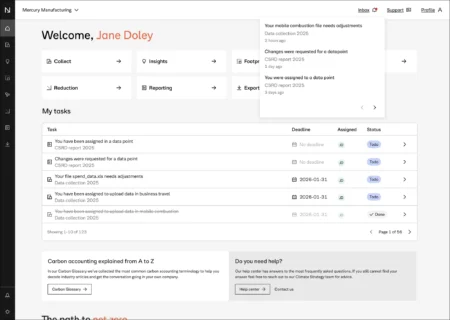
All you need to do is upload your data into Normative’s carbon management platform and watch the system instantly categorize recurring values. Then, jump into categorization view to see which matches have been made and why, before the Normative team carries out the standard QA process to make sure your business’ data is accurate and audit-ready.
Get started today: speak with our experts
Uncover how Categorization Memory can get your carbon emissions reports audit-ready, year-in-year-out, while giving precious time back to your team. Speak with one of our climate specialists today.
FAQs
Categorization Memory remembers how your data was categorized in past uploads and automatically applies those same categorizations when the same or similar data appears again.
In the new categorization view, each row will clearly show whether it was auto-applied from memory (exact or partial match) or suggested by the LLM-supported prediction service.
No. All uploaded data continues to go through Normative’s standard QA process to ensure accuracy, completeness, and GHG Protocol alignment. Categorization Memory simply reduces repetitive review and speeds up processing and enables you to see your preliminary emissions faster.
Automating categorization of your carbon emissions data is a key way any business can streamline its carbon emissions reporting. It reduces manual work, improves consistency, and helps you get from upload to emissions calculation much faster.