PCFs that impact product design, not historic reports

Normative’s Product Carbon Footprint (PCF) tool gives product designers and sustainability leads the calculation layer their work deserves, through AI-powered Bill of Materials (BOM) ingestion, material-level hotspot analysis, and scenario simulation.

Already used by product teams calculating PCFs across industrial electronics, furniture, apparel, and consumer goods.

See how it works

How this will benefit you

Who is this page for?

  • This page is for the product designer or sustainability lead who builds PCFs, or who should be building them, but currently can’t do it at the pace the work demands.

    You care about designing better products and know that carbon is increasingly part of what “better” means.

    This tool is built for the gap between those two facts.

The challenge

Your expertise is in the product. Your time keeps ending up in the spreadsheet.

You care about designing products that are better: better materials, better decisions, better credentials to take to market. Carbon is now an important part of that consideration, with your customers, manufacturers and compliance team all asking about it. 

But the process you currently rely on gives you a number you can’t trace, delivered too late to change anything, in a format you have to justify all the time. That is not a data problem. That is a design process problem. And it sits in exactly the part of your work that requires the most expertise.

  • Data ingestion consumes the calendar

    Before you calculate a single emission, you are reformatting files, splitting columns, matching units. That is not PCF work. It is the work that happens before the work.

  • The number lands without context

    A PCF result that tells you the total without showing you which 20% of your materials are driving 80% of the footprint, is a compliance artifact, not a design input.

  • Credibility is always uncertain

    You deliver a PCF and immediately wonder: is this ISO 14067-aligned? Is this certifiable? Can I share this with the brand team without caveats? You should not have to wonder, it should be confirmed before you export.

The solution

PCF software for product design: turn a design brief into a footprint

Learn more

Normative PCF removes the volume work so your team can focus on the judgment work, when it really matters.

Once you import your BOM, the AI maps it and you get the chance to review the details. With that, the footprint is delivered in a format that is shareable, auditable, and useful – not just a number in a spreadsheet that nobody trusts.

What that makes possible is the step that comes after the calculation. The hotspot breakdown that tells you exactly which material decisions to revisit, or the compliant result that lands in a customer portal the same day. And the best part? You can run scenarios before the design is locked, so your PCFs can actually impact design decisions, not just report on what happened in the past.

Your BOM, processed in minutes, not re-entered over days

BOM-to-emissions automation

Upload your bill of materials in whatever format it already exists in. Normative’s AI reads the structure, identifies each component, and matches it to the right emission factor automatically. What your team spent days doing, you now review in an hour.

Components you have categorized before are remembered, so every new product that shares a material or sub-assembly inherits the work that’s already been done. The manual grind ends at the upload button.

Feature callouts:

  • BOM parsing across CSV, Excel, and multi-format inputs
  • AI component-to-emission-factor matching with confidence indicators
  • Categorization memory that’s consistent across every product, every time

Every footprint tells you exactly where to look next

Carbon hotspot analysis

A PCF number without context is a compliance artifact. A PCF number with hotspot visibility is a design brief.

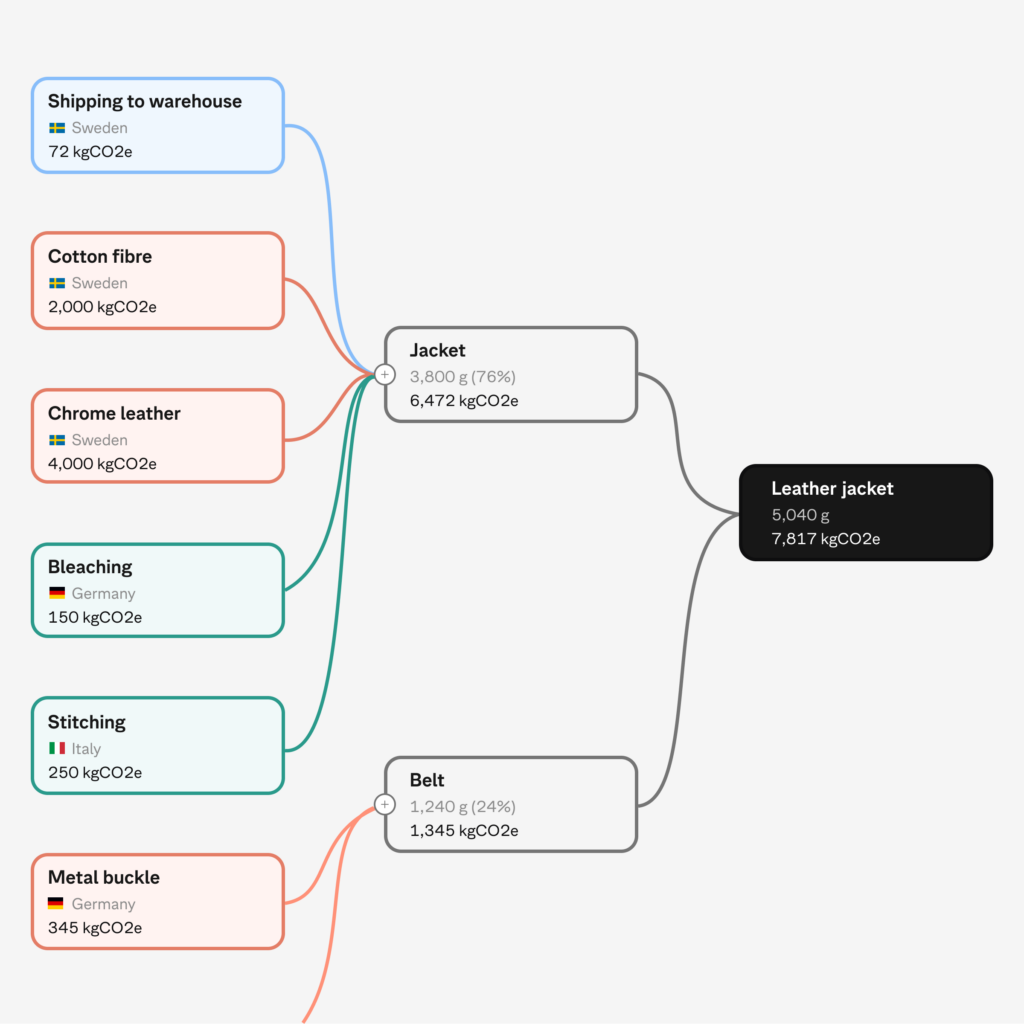
Normative shows you, product by product and portfolio-wide, which materials and components are responsible for most of the emissions. Not in a report you download and open in a separate tab, but directly in the tool, immediately after calculation.

Feature callouts:

  • Per-product carbon breakdown by material, component, and packaging
  • Portfolio hotspot view where top emitters are ranked across your entire catalog
  • Material share and carbon intensity metrics alongside absolute figures
  • Emission factor source shown for every line item, providing full auditability from day one

Your next material decision is also a carbon decision. Now you can see both at once.

Material scenario simulation

The most expensive moment to reduce a product’s carbon footprint is after it ships. The cheapest moment is before the design is finalized. That gap, between when you choose materials and when the emissions consequences become visible, is where Normative PCF operates.

Swap a material, change a country of origin, shift a manufacturing process, and see the emissions impact alongside your current version. Now you can share this comparison with the sourcing team, or stakeholders in procurement, to make a pre-emptive decision based on the data, not an intuitive one. This is where Normative shifts from a compliance tool to a design tool, and where your sustainability credentials become production-ready, not just defensible.

Feature callouts:

  • Side-by-side material substitution comparisons
  • Simulate changes to origin, process, and packaging
  • Exportable scenario reports for design and procurement review
  • AI-generated reduction suggestions based on your product’s actual hotspot data
 

How it works in three steps. Then the work that actually matters.

From BOM, to PCF, to action

Start your journey
  • Step 1: Import your BOM

    Upload your existing bill of materials in the format you already use. Normative reads it, the AI maps components to emission factors, and you get a reviewable table with accuracy scores and source references. You validate. You do not re-enter.

  • Step 2: Review and confirm

    Check the AI’s categorization at whatever level of depth fits your portfolio. Complex product with specific material requirements? Review line by line. Either way, every match is shown with its source, so the result is yours to own, not ours to defend.

  • Step 3: Analyze, simulate, act

    Your PCF is ready. You can explore which materials are driving the most emissions, run a scenario comparison, and share PACT-aligned footprints with customers, auditors, or your sourcing and commercial colleagues. Now you can also feed product-level data into your corporate carbon accounting, with every downstream use case already supported.

Start your journey

FAQs

Normative’s ingestion engine is built to accept BOM structures across multiple formats, not just one template. Components are matched by material type and description, not by column position. If a component mapping is not confident, you will see it flagged for review rather than silently approximated.

No. Normative’s component library lets you define a material or sub-assembly once and reuse it across every product that uses it. When the emission factor for a shared component updates, it updates across your entire portfolio simultaneously.

ISO 14067 (the primary PCF standard), GHG Protocol Product Standard, EU PEF methodology, and WBCSD PACT / Pathfinder V2.0. The alignment status of each PCF in your portfolio is tracked and visible so you know exactly which products are shareable under which framework.

Directly. Product-level footprints feed into your Scope 3 Category 1 figures, replacing spend-based estimates with primary product data. It is the natural upgrade path, and for customers already on the platform, it requires no new data infrastructure.

Ecoinvent, Carbonminds, Agribalyse, and Exiobase are the primary sources. Every emission factor shown in the tool includes the source database, version, and last-updated date. There are no black boxes in Normative PCF.

Get started with PCFs

Stop explaining your process. Start trusting your output.

Normative PCF is in early access. Join the cohort of product teams replacing their manual PCF workflows with calculation infrastructure that was built for the scale and precision this work requires.

See how it works