PCF vs LCA: which carbon assessment method do you need? (2026)

Understand the difference between PCFs and LCAs, when to use each and what regulations require.

A product carbon footprint (PCF) and a life cycle assessment (LCA) are related but distinct methodologies: a PCF is an LCA scoped to a single environmental category. A full LCA measures impact across 16 or more categories including climate change, water use, land use, and toxicity. Meanwhile, a PCF focuses exclusively on the climate change category: greenhouse gas emissions across the product’s lifecycle, expressed in kg CO₂e. So, while every PCF follows LCA methodology, not every LCA is a PCF.
For most commercial drivers in 2026, such as regulatory deadlines, buyer data requests, and supply chain carbon transparency, a product carbon footprint is what is needed. Understanding the difference between a full life cycle assessment and a product carbon footprint is critical to determine whether businesses are solving the right problem at the right cost.
What is the difference between a PCF and a full LCA?
The difference between a PCF and a full LCA comes down to scope. Both follow the same underlying methodology framework, governed by ISO 14040 and ISO 14044. Where they diverge is in what they measure.
A full LCA covers 16 or more environmental impact categories: climate change, water use, land use, acidification, ecotoxicity, particulate matter, resource depletion, and more. A PCF applies the same methodological rigour, but it does so for the climate change impact category only – greenhouse gas emissions expressed as kg CO₂e, governed specifically by ISO 14067.
The practical consequences of that difference are substantial, as you can see in the table below:
| Dimension | Full LCA | Product Carbon Footprint (PCF) |
| Scope | 16+ environmental impact categories (such as acidification, eutrophication, land use, water scarcity, ecotoxicity, particulate matter) | GHG emissions only (kg CO₂e) |
| Standards | ISO 14040/14044 | ISO 14067, GHG Protocol Product Standard |
| Complexity | Often requires LCA specialist practitioners | Increasingly automated; more accessible for sustainability managers and product teams |
| Time to produce | Weeks to months per product | Days to weeks with software |
| Cost | Can cost tens of thousands per product (consultant-led) | Significantly lower per-product cost at scale (software-enabled) |
| Update frequency | Periodic, typically annual or less | Can be continuous or triggered by Bill of Materials (BOM) changes |
| Primary users | Sustainability consultants, LCA practitioners | Product managers, procurement, supply chain |
| Market trajectory | Stable, established | Rapidly growing and democratizing |
The key implication: because every PCF is built on LCA methodology, a software-enabled PCF does not sacrifice methodological integrity. It focuses that methodology where current regulatory and commercial demand is concentrated.
When do you need a full LCA, and when is a PCF enough?
There are contexts where a full LCA is genuinely the right approach.
A full LCA is appropriate when:
- You need an Environmental Product Declaration (EPD). EPDs for construction, chemicals, and building materials require multi-impact assessments under EN 15804 or sector-specific rules, not a carbon-only result
- You are making broad environmental claims beyond carbon. Any multi-dimensional claim about lower water impact, reduced toxicity, or reduced land use requires LCA data for each category claimed, particularly under EU Green Claims Directive substantiation requirements
- Detailed ecodesign work requires the complete environmental impact picture across all categories, not just carbon
- Academic or scientific research requires full methodological scope under ISO 14040/14044
A PCF is sufficient when:
- You are responding to a regulatory requirement. CSRD Scope 3 Category 1, the EU Digital Product Passport, and PACT-aligned B2B data exchange all specify carbon or GHG data, not a full multi-impact LCA (see the regulation section below)
- An enterprise customer has requested product-level carbon data to satisfy their own Scope 3 reporting obligations. What they need is PCF data, because that is what their CSRD obligation specifies
- You are substantiating a carbon-specific environmental marketing claim. ISO 14067 alignment is the baseline required for any auditable carbon claim under the Green Claims Directive
- You are building a product carbon programme for the first time. A PCF provides the audit-ready starting point, and specific full LCA work can be added for particular products where the broader impact picture is needed later
For the vast majority of companies facing regulatory or commercial PCF requirements in 2026, a PCF aligned to ISO 14067 and the WBCSD PACT/Pathfinder Framework is both necessary and sufficient. Commissioning a full multi-impact LCA for a compliance use case over-engineers the solution without improving regulatory standing.
How do the standards differ between PCF and LCA?
- ISO 14040 and ISO 14044 are the foundational LCA methodology standards. ISO 14040 covers principles and framework; ISO 14044 covers requirements and guidelines for conducting an LCA. These underpin all LCA work, including every PCF calculation.
- ISO 14067 is the specific PCF standard, built on the ISO 14040/14044 framework but scoped to GHG emissions. When a regulator, a customer, or an auditor asks for an “auditable PCF,” ISO 14067 compliance is what they mean.
- The GHG Protocol Product Standard provides supplementary guidance aligned with ISO 14067 and is particularly relevant for companies also reporting under the GHG Protocol Corporate Standard. It ensures consistency between product-level and corporate-level emissions accounting.
- The WBCSD PACT/Pathfinder Framework governs how PCF data is exchanged across supply chains via standardized API. This is a PCF-specific data exchange protocol, not an LCA standard, and it is what enterprise buyers increasingly mean when they ask suppliers to share “PACT-aligned” product carbon data.
- The EU Product Environmental Footprint (PEF) methodology sits across both: it covers multiple environmental impact categories like a full LCA, but includes climate change/PCF as a required category. PEF is the methodology basis for EU Green Claims Directive substantiation for broader environmental claims.
The practical upshot: a PCF built to ISO 14067 can, with appropriate documentation, satisfy PACT and PEF requirements from the same underlying dataset. There is no need to run a full LCA in parallel to satisfy these frameworks.
How do the costs and timelines compare?
Consultant-led full LCA engagements for complex manufactured goods typically run into the tens of thousands per product, reflecting specialist time for data collection, impact modelling across all categories, peer review, and formal documentation. Delivery takes weeks to months depending on supply chain complexity and data availability, while each update – a supplier change, a BOM revision, or a new reporting period – requires a new consultant engagement. At the end of this lengthy process, businesses receive a static report and the methodology knowledge stays with the consultant, not the company.
Software-enabled PCF works differently. For a single product with a well-structured Bill of Materials, a first auditable result can be produced in days. At portfolio scale, the fixed cost of software is spread across the full catalogue, reducing per-product cost significantly.
The comparison shifts further when you account for updates. A consultant-delivered LCA requires re-engagement every time something changes. PCF software gives the company ownership of the methodology: when a supplier changes, a new framework is required, or a product variant is added, the calculation is updated within the existing system, not commissioned as a new project.
Your guide to calculating a PCF
For a step-by-step guide to:
- The PCF calculation process
- Data requirements
- Emission factor selection
read this article from one of Normative’s GHGP-certified experts.
Read the article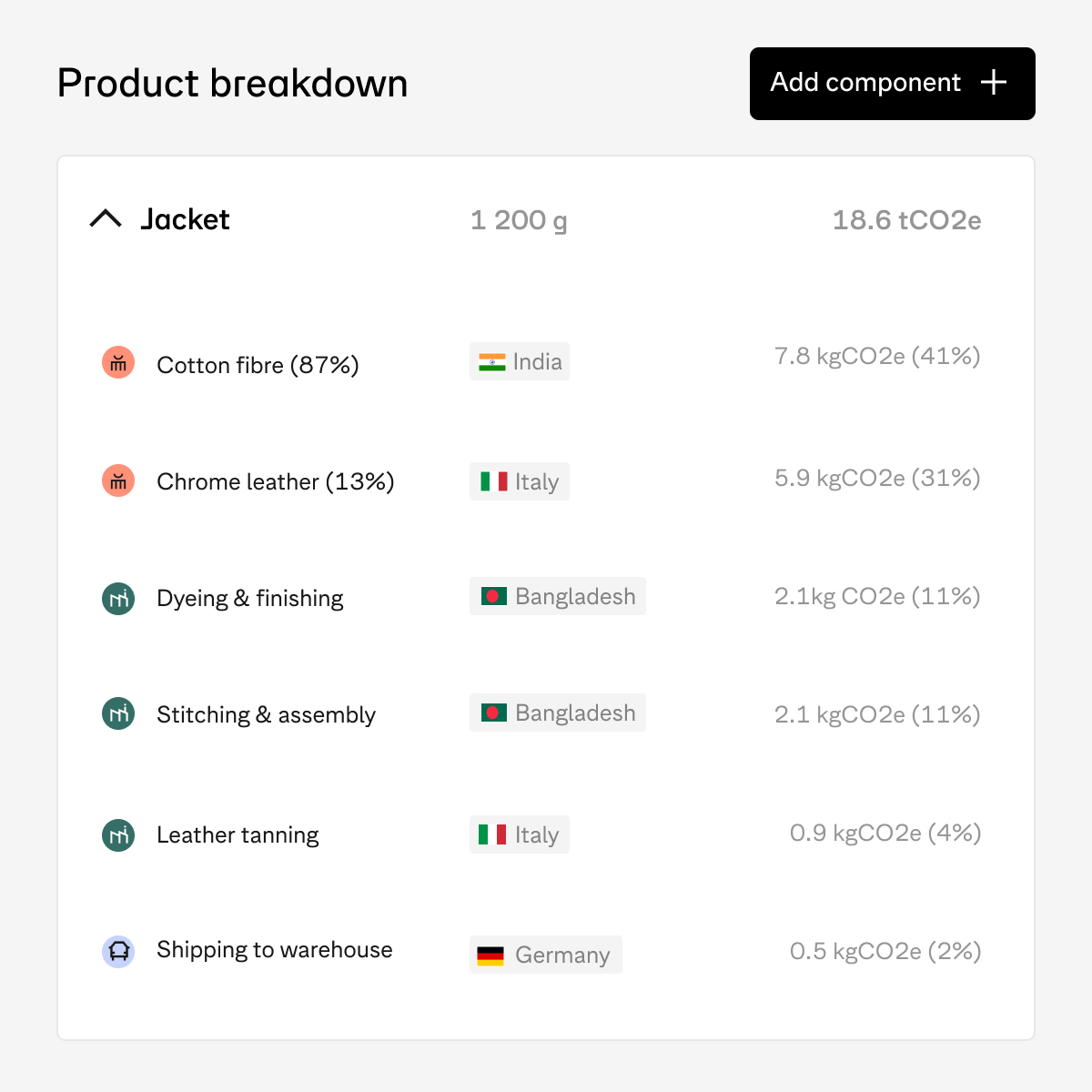
Which approach works at portfolio scale?
The cost and timeline comparison becomes more stark when the requirement is not one product but a full product catalog.
LCA consultancies cannot practically scale to a catalogue of hundreds or thousands of SKUs. The specialist time required and the engagement cost compound with every product. Companies in the beta programme for Normative’s PCF tool that came from a consultancy-led model described the reality directly: creating PCFs manually for thousands of products simply will not work.
Specialist LCA software tools, platforms such as Sphera/GaBi or SimaPro, are powerful and methodologically rigorous, but are built for LCA engineers and practitioners. For a sustainability team without a trained LCA specialist on staff, these tools require hiring one or engaging external consultants to operate them. For mid-market manufacturers without a dedicated LCA function, this is a significant constraint.
PCF software is built for portfolio-scale calculation: automated BOM ingestion, consistent emission factor mapping across the catalog, variant management across product families, and audit trail generation without manual documentation per product. In Normative’s beta programme, every one of the customers involved identified data ingestion, getting BOM and materials data into a structured, mappable form, as the primary bottleneck in PCF production, ahead of methodology questions, compliance uncertainty, or calculation accuracy. That is the problem scale-ready PCF software solves.
For a deeper look at what scaling PCFs across a product portfolio requires in practice, check out our insights post on scaling product carbon footprints to meet global buyer demand.
What does regulation actually require: PCF or LCA?
This is the question that resolves most buyer confusion. The answer, across every major current regulatory driver, is PCF, not a full multi-impact LCA.
| Regulation | What it requires | PCF or full LCA? |
| CBAM (full compliance Jan 2026)* | Embedded carbon per product unit for steel, aluminium, cement, fertilizers, electricity, and hydrogen imported into the EU | PCF: embedded GHG content per unit |
| CSRD Scope 3 Category 1 | Product-level emissions data from suppliers for Purchased Goods & Services disclosures | PCF: supplier product carbon data, not a multi-impact assessment |
| WBCSD PACT/Pathfinder Framework | Standardized B2B PCF data exchange via API | PCF: this protocol is PCF-specific |
| EU Green Claims Directive (expected H2 2026) | Substantiated environmental marketing claims | PCF minimum for carbon-related claims; PEF or full LCA required only for broader multi-category environmental claims |
| EU Digital Product Passport (rolling out from 2027) | Machine-readable product-level environmental data | PCF: carbon footprint is a core mandatory data field |
*CBAM uses a distinct methodology from ISO 14067-aligned PCFs. “Embedded emissions” under CBAM covers direct facility emissions and electricity-related indirect emissions from the production process only, not the full upstream scope typical in a PCF. Where actual production data is unavailable, CBAM permits use of EU Commission default values, which ISO 14067 does not allow for a verified PCF.
CSRD Wave 1 companies filed their first disclosures in 2025. Many are now using PCF capability as a procurement filter, requiring suppliers to provide product-level carbon data as a condition of continued business. The data request arriving in a supplier’s inbox is a direct consequence of someone else’s CSRD reporting obligation. That obligation specifies PCF-level data.
Not one of these five major requirements asks for a full multi-impact LCA. Companies that commission a full LCA on the assumption it satisfies these obligations are paying for significantly more than the regulation or the buyer is asking for.
Decision framework: PCF or LCA?
| Your situation | Recommended approach |
| Regulatory deadline: CBAM, CSRD, DPP | PCF: ISO 14067-aligned, PACT-compatible |
| Enterprise buyer requesting carbon data for their scope 3 reporting | PCF: this is what their CSRD obligation specifies |
| Carbon label or carbon-specific marketing claim (EU) | PCF: EU Green Claims Directive requires substantiated carbon data |
| Full environmental label or multi-category claim | Full LCA: requires data across all impact categories claimed |
| Environmental Product Declaration (EPD) in construction or chemicals | Full LCA: EPD standards require multi-category assessment |
| Product design optimization, starting with carbon hotspots | PCF: run hotspot analysis first; full LCA only if the complete environmental impact picture is needed for specific design decisions |
| Ecodesign material scenario simulation | PCF with scenario modelling: see how BOM-level material swap scenarios work for product designers |
| Academic research or scientific publication | Full LCA: ISO 14040/14044 full scope required |
| Starting a product carbon programme for the first time | PCF: lower barrier to entry; directly satisfies current regulatory and commercial demand |
| Scaling across 100+ SKUs | PCF with software: consultancy-led LCA & PCF does not scale to portfolio level |
A company can start with PCF and commission full LCA for specific products or use cases as needed. The two approaches are not mutually exclusive, a PCF dataset built to ISO 14067 is the foundation any future LCA work can build on.
FAQs
A PCF is not the same as a full LCA, but it uses the same underlying methodology. A full LCA measures environmental impact across 16 or more categories including climate change, water use, land use, toxicity, and resource depletion.[¹] A PCF applies LCA methodology to the climate change category only, measuring greenhouse gas emissions in kg CO₂e. ISO 14067 governs PCF quantification; ISO 14040/14044 governs the broader LCA methodology that underpins both.
A full LCA is the right choice when you need multi-dimensional environmental impact data beyond carbon: for Environmental Product Declarations (EPDs), substantiation of broad environmental claims across multiple impact categories, or detailed ecodesign work requiring a complete impact picture. For regulatory compliance (CBAM, CSRD Scope 3 Category 1, DPP), B2B customer data requests, and carbon-specific marketing claims, a PCF is what is specified and is sufficient.
Full LCA methodology is governed by ISO 14040 (principles and framework) and ISO 14044 (requirements and guidelines). PCF is governed by ISO 14067, built on the LCA framework but scoped to GHG emissions. For B2B supply chain data sharing, the WBCSD PACT/Pathfinder Framework sets out PCF-specific data quality and exchange requirements. A PCF built to ISO 14067 can, with appropriate documentation, satisfy PACT and EU PEF requirements from the same underlying dataset.
Consultant-led full LCA engagements typically run into the tens of thousands per product for complex goods, with delivery in weeks to months. Software-enabled PCF calculation significantly reduces per-product cost, particularly at portfolio scale, where the fixed cost of software is spread across hundreds or thousands of SKUs. The comparison shifts further when you account for update costs: a consultant-delivered LCA requires re-engagement for every material change; PCF software allows updates without a new consultancy project.
Current EU regulations specify PCF-level carbon data, not a full multi-impact LCA. CBAM requires embedded carbon content per product unit. CSRD Scope 3 Category 1 requires supplier product-level emissions data. The EU Digital Product Passport specifies product carbon footprint as a core mandatory data field. The EU Green Claims Directive requires PCF data to substantiate carbon-related marketing claims. None of these major 2026 regulatory drivers require a full multi-impact LCA.
Ready to build your first PCF?
If you’re assessing whether you need a PCF or a full LCA, or you’re ready to build your first PCF, get in touch with our experts.
Normative PCF handles the biggest challenge businesses face with product-level emissions – BOM ingestion. Find out how you can deliver audit-ready PCFs in record time.