How to reduce your carbon footprint at work: a practical guide for businesses

3 steps to reduce your business’s carbon emissions and meet regulatory pressure, consumer demand, and climate targets.



Most companies want to reduce their carbon footprint. Few know which decisions actually move the number, or where to start at work.
The challenge is rarely willingness. It is knowing which workplace decisions matter, in what order, and trusting the data behind them. A travel policy change might cut more emissions than a year of recycling drives. A supplier switch can dwarf both.
This guide covers what a credible carbon reduction plan looks like for a business: the workplace decisions you can act on this quarter, the supplier and scope 3 work that takes longer, and the targets that hold up to scrutiny from auditors, customers, and investors.
Read this if you are responsible for sustainability at your company and need a framework that will hold up when finance asks how you got the number, and the board asks whether it is enough. Here are some reasons to keep reading:
- Regulatory pressures are mounting from legislation such as the EU’s CSRD and CSDDD and the UK’s SECR.
- Consumer preferences have made sustainability a business necessity – in 2023, one in three consumers stopped purchasing a brand or product due to sustainability or ethical concerns.
- The consequences of climate change demand urgent mitigation action to minimize economic damages and to keep the planet habitable, as the world strives to get on a Paris-aligned path to net zero.
What changes can you identify in your business’s processes, policies, technology, and supplier relationships to reduce emissions? How can you turn well-intentioned strategies and targets into tangible results?
This article shares a hands-on guide to reducing your business’s carbon emissions, in three steps:
- Build a foundation of comprehensive carbon data to empower strategic action.
- Set well-informed targets based on industry best practices and your company’s specific situation.
- Create and implement strategic emissions reduction initiatives to meet your targets.
Guiding you from the initial planning to the tracking of your results, this article will help you put your business on a path to net zero.
Step 1: Build a foundation of comprehensive carbon data
There’s a business adage that holds true when it comes to decarbonization: “You can’t manage what you can’t measure.” If you can’t see your carbon, you can’t address it.
Making your business’s emissions visible is the first step towards meaningful climate action – which is where carbon accounting comes in.
Carbon accounting is similar to financial accounting in that it quantifies the impact of an organization’s business activities, though it tracks climate impact instead of financial impact.
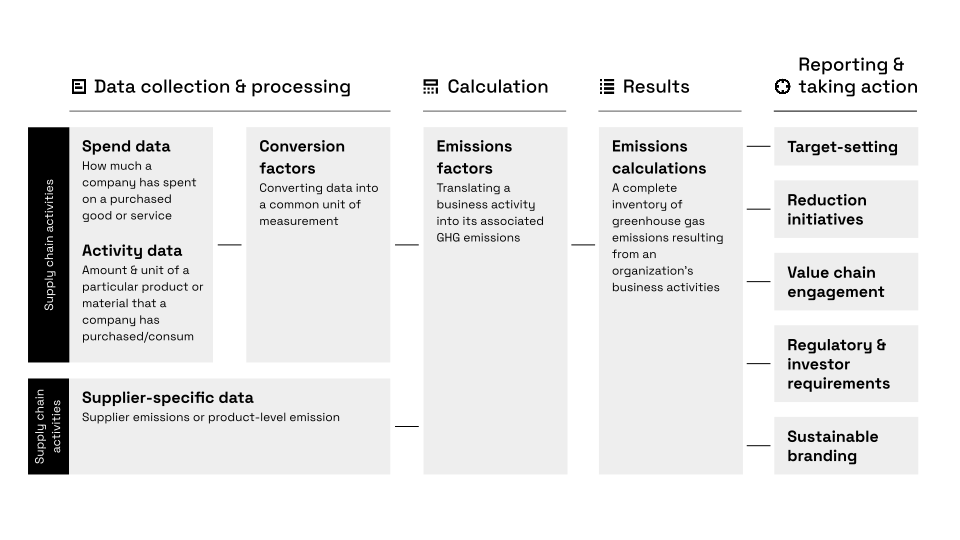
Gaining full visibility over all of your emissions requires collecting data not just from within your organization but also from your value chain – the business activities in scope 3.
Your value chain work is key to making significant reductions to your business’s carbon footprint. Value chain emissions are often the largest source of emissions for businesses and therefore the largest source of carbon reduction potential.
88%
The value chain emissions in scope 3 account for approximately 88% of emissions, according to a CDP examination of businesses across sectors.
Because the value chain encompasses all upstream and downstream activities, from purchasing raw materials to the end-of-life treatment of sold products, data collection is a particular challenge.
To quantify these emissions accurately you’ll need to engage with your value chain, which requires navigating relationships with hundreds or even thousands of suppliers and service providers.
To meet the scale of this challenge, turn to Normative’s Carbon Network to source primary supplier data and foster collaborative reduction projects!
The Carbon Network is a global solution for a global challenge
Use the Carbon Network to collaborate with suppliers for sourcing data, uncovering scope 3 emissions insights, and driving real carbon reductions.
Learn more about the Carbon Network
Where the reductions actually come from at work
Most carbon footprint reductions at work come from three categories of decision: how you run your office, how your people travel, and what you buy. Each sits in a different emissions scope, and each has a different rhythm. Some changes show up in the data within a quarter. Others take a year or more to compound.
At the office (scope 1 and 2)
Direct emissions from heating systems, vehicles you own, and any fuel burnt on site sit in scope 1. The electricity you buy from the grid sits in scope 2. Together these are the easiest to measure and the easiest to act on.
The highest-impact moves:
- Switch to a renewable electricity tariff or sign a Power Purchase Agreement (PPA) for direct supply
- Upgrade HVAC and lighting controls, especially in older buildings
- If you operate a vehicle fleet, plan electrification across the next replacement cycle
- Where the site supports it, install on-site solar
For a typical UK office-based business, the renewable electricity switch alone can remove the majority of scope 2 emissions in a single financial year.
Business travel and commuting (scope 3)
Business travel sits in scope 3 alongside commuting and remote work. It is often underestimated because the data is fragmented across expense systems, travel agents, and corporate cards.
The highest-impact moves:
- A rail-first travel policy for journeys where rail is reasonable. The carbon difference between a one-hour flight and a four-hour train can be a factor of ten.
- A virtual-first meeting culture, supported from the top. This only works if leadership treats virtual attendance as equally valid.
- Commuting incentives: cycle schemes, season ticket loans, EV salary sacrifice. These reduce scope 3 commuting and signal culture.
- A remote and hybrid policy that accounts for the home energy mix of your workforce. Remote work is not automatically lower-carbon.
Procurement and suppliers (scope 3)
For most companies, scope 3 supply chain emissions account for 70 to 90% of the total carbon footprint. This is where the biggest reductions live, and the category most companies postpone because the data is hardest to get.
The highest-impact moves:
- Add carbon criteria to your supplier selection process, with the same weight you give cost or quality
- Engage your top ten emitting suppliers on their own reduction targets
- Specify lower-carbon inputs and packaging at the design stage, not after
- Join an SBTi supply chain engagement program to align supplier targets with the standard your customers will expect
The supplier work compounds. A supplier who reduces their own footprint reduces yours every year afterwards. A renewable electricity switch is one-off. A supplier program is a flywheel.
Step 2: Set well-informed targets
Once you have a comprehensive view of your organization’s carbon emissions, you can move on to the next critical step: using your emissions data as a baseline for target setting.
There are several approaches to target setting; understanding the target-setting frameworks is key to establishing goals that are both ambitious and achievable.
Two of the most important things to consider when setting your targets are whether you will externally validate your targets and what the targets’ time horizons are. The following sub-sections will explore both of these concepts in detail.
Target validations
Your business can apply to have its emissions targets validated by a third party. You might do so to signal to consumers and investors that you are taking your climate responsibility seriously, and to prove that your targets are in line with science.
The Science Based Targets initiative (SBTi) is the most prominent framework for target validation.
When your organization’s targets are validated by the SBTi, the minimum level of ambition is informed by SBTi target-setting guidelines which are based on a Paris-aligned path to net zero – though you may choose to set more ambitious emission reduction targets.
How to set SBTi-approved climate targets: learn from Norican’s journey
With Normative’s support, the industrial machinery manufacturer Norican became the first in its industry to set SBTi-approved climate targets.
Read the success story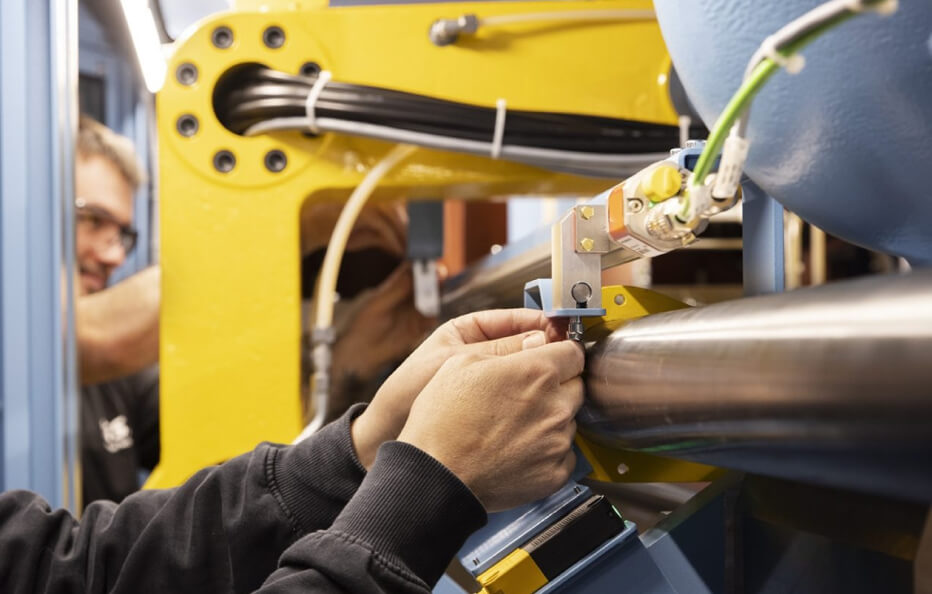
Other notable third-party frameworks include the UN Race to Zero, The Climate Pledge, PlanetMark, and the Exponential Roadmap Initiative.
Additionally, you can have your emissions reporting audited for third-party verification, adding credibility to any statements you make about your progress toward your goals.
Even if your company prefers not to invest in validation, you can still set targets in line with science and maintain accountability by publishing them in your sustainability report and discussing progress.
You may also choose to set both publicly validated external targets alongside internal targets that may be either more ambitious for parts of your organization or less ambitious for areas where rapid decarbonization is more challenging.
Target time horizons
Targets can be grouped into two time horizons:
- Near-term targets: with a target year in the next 5-10 years.
- Long-term target: with a target year of 2050 or before.
These time horizons were established by the previously-mentioned SBTi. Emissions targets with time horizons beyond 2050 are not considered “science-based” because they are not compatible with the Paris Agreement-aligned goal of limiting global warming to well below 2°C, preferably not exceeding 1.5 °C.
The table below breaks down four common target types and their time horizons, and shares a hypothetical example of each target.
Common types of climate targets:
| Target type | Description | Hypothetical example target |
|---|---|---|
| Supplier/customer engagement target (Near-term only) | Targets aimed at reducing emissions from upstream and downstream activities through engaging suppliers or buyers. For SBTi validation, these targets should be fulfilled within a maximum of 5 years from the date the company’s target is submitted to SBTi. | The 8 suppliers that are responsible for 70% of our emissions in Purchased Goods and Services will set science-based targets by 2027. |
| Absolute reduction (Near-term and long-term) | Targets that aim for a direct decrease in GHG emissions of a specified amount (as opposed to emissions intensity). | We will reduce our absolute scope 1, 2, and 3 GHG emissions 90% by 2040 from a 2019 base year. |
| Physical and economic intensity reduction target (Near-term and long-term) | Targets that reduce emissions relative to physical output or economic value (as opposed to absolute emissions). | We will reduce our scope 3 emissions by 50% per unit of product by 2030 from a 2020 base year. |
| Renewable electricity target year (Near-term and long-term) | Targets for achieving a certain percentage of renewable electricity by a target year. These targets are specific to scope 2. | We will source 80% of our electricity from renewable sources by 2025 and 100% by 2030. |
Step 3: Create & implement strategic emissions reduction initiatives
Reduction initiative – Any change, or set of changes, that could hypothetically lower the emission impact of a particular business activity.
Understanding how to create strategic reduction initiatives is key to your business’s climate strategy.
Emission reduction can be categorized into active changes made by your organization and passive benefits that occur due to broader market trends.
- Passive benefits are the impact of macro emission-reduction trends on the products and services that your organization is buying and selling. This trend is driven by the aggregate demand for lower-emission products and services and legislative changes.
- Active changes require your organization to do something differently. This might involve altering a process or policy, enhancing efficiency, or choosing different products and services – either from your existing suppliers or new ones.
A prime example of a passive benefit is the “greening” of national energy grids, which will reduce the emission impact of energy consumption over time for many businesses even without the businesses making any changes to energy suppliers or usage.
By contrast, an example of an active change is when the team at Flying Tiger Copenhagen used its carbon data to pinpoint an emissions hotspot in textiles. The team had a strategy in place for reducing emissions from solid materials like plastic, but no strategy for textiles. With help from Normative, the team began suggesting lower-carbon alternatives for Flying Tiger Copenhagen’s suppliers.
Active changes can be further broken down into two types of initiatives: substitutions and energy improvements. We take a deep-dive into both these initiative types in this article.
Two impactful carbon reduction approaches for your business
Drive carbon reductions throughout your business by using these two types of initiatives: substitutions and efficiency improvements.
Learn more in our article
When creating a climate strategy for your company, your focus should be on active reduction initiatives, as these are the types of changes you have the most control over.
However, that’s not to say that you will have full control over all active reduction initiatives. Some changes can be executed internally, some will require collaboration with your value chain, and others may even necessitate finding new suppliers.
The feasibility of implementing a change is influenced by several factors, which often overlap. The table below gives some common feasibility factors, the considerations you may confront in implementing them, and a tangible example in the use case of installing solar panels.
Reduction initiative factors & considerations:
| Factor | Considerations | Hypothetical use case: solar panels |
|---|---|---|
| Cost | What are the upfront and ongoing costs? Is it affordable? | Installing solar panels will have a high initial cost for your business, but will save money over time. |
| Availability | Is the technology or solution accessible based on geography or market? | Solar panels are in short supply in your region, and there is a long delay before you will be able to install them. |
| Operational Feasibility | Do you have the capability to implement the change? Consider skills, lock-in, and inertia. | You might be locked into an energy supplier contract or renting office space with no control over energy decisions. |
| Utility of Change | Will the change negatively affect your ability to meet business needs? | Solar panels are less effective during cloudy weather, and your region is often cloudy, meaning you may experience disruptions to your electricity supply. |
| Time Efficiency | Is there enough time to implement the change within the required timeframe? | Solar panel installation would not be complete until 2032, but you have a 2030 renewable energy target. |
| Innovation | Are you waiting for technology to improve in efficiency or quality? | It only makes financial sense for your business to install solar panels once they reach a certain efficiency level, and they have not yet reached it. |
When it comes to reducing emissions, the question often arises: Shouldn’t organizations implement every possible change to cut down on carbon?
The reality is that while a change may indeed reduce emissions, it doesn’t necessarily mean that your business can practically make that change. Targets must strike the balance between having too high of a bar – resulting in a lack of motivation if not achieved – and having too low of a bar, which would not keep pace with the scale of change needed.
The feasibility criteria above are crucial for understanding which reductions are quick wins, which require long-term planning, and which are simply not viable.
This is where the strategic value of creating forward-looking, hypothetical reduction initiatives comes into play. By anticipating the emission reductions of potential changes before implementing them, organizations can avoid wasting time, money, and resources on ineffective actions.
With this in mind, Normative’s climate experts have put together a checklist for creating impactful and pragmatic reduction initiatives:
A realistic sequencing plan for your first 24 months
The companies that reduce fastest are not the ones with the most ambition. They are the ones who sequence the work so quick wins fund the harder, longer programs.
| Phase | Focus | What you should have at the end |
|---|---|---|
| 0 to 3 months | Build a credible scope 1 and 2 baseline. Switch office electricity to a renewable tariff. Update business travel policy. Begin scope 3 spend-based estimates. | A defensible first carbon number, signed off by finance. Travel policy live. First reduction visible in next quarter’s data. |
| 3 to 12 months | Complete full scope 3 measurement, moving from spend-based to activity-based data where possible. Engage top suppliers. Set near-term SBTi-aligned targets. | Baseline complete and submittable. Targets validated. Reduction roadmap mapped to specific initiatives. |
| 12 to 24 months | Year-on-year remeasurement against the baseline. Scale supplier engagement. Implement product, operational, and procurement changes informed by year one data. | First validated year-over-year reduction. Defensible reporting for CSRD, SECR, and customer requests. Compounding effect from supplier program visible. |
The 12-month checkpoint is where most carbon programs either accelerate or stall. The companies that accelerate are the ones who built a baseline they trust. Trust in the number is what makes the next decision easier.
Checklist: creating a reduction initiative
- Define a current business activity and its emission impact in carbon dioxide equivalents (CO₂e).
- Define a proposed alternative activity and its emission impact in CO₂e.
- Find the reduction potential of the proposed alternative, which is calculated with the following simple formula:
(CO₂e current) – (CO₂e proposal approach) = Reduction potential - Compare the reduction potential versus the feasibility of the current and proposed activities.
- Create a timeline for implementation.
Using this checklist to clearly understand the potential impact of your actions, you can confidently invest in efforts that will contribute to meeting your climate targets and business goals.
In conclusion
All of these steps toward carbon reduction have one pre-requisite: emissions data.
To effectively plan, implement, and monitor reductions, you need comprehensive and high-resolution data about your carbon emissions.
Normative is here to support your carbon reduction work. Our science-backed carbon accounting platform gives you a powerful tool to drive your sustainability efforts and includes a suite of reduction features. Our automated value chain engagement empowers you to refine your scope 3 calculations and track your reduction progress. And our team of Climate Strategists will guide you along every step of the path, from zero to net zero.
Learn how Normative can support your carbon reduction work
Frequently asked questions
There are three compelling imperatives for why your business should reduce its emissions:
- Regulatory pressures are mounting from legislation such as the EU’s CSRD and CSDDD and the UK’s SECR.
- Consumer preferences have made sustainability a business necessity – in 2023, one in three consumers stopped purchasing a brand or product due to sustainability or ethical concerns.
- The consequences of climate change demand urgent mitigation action to minimize economic damages and to keep the planet habitable, as the world strives to get on a Paris-aligned path to net zero.
There are three broad steps that will guide you through reducing your business’s carbon emissions:
- Build a foundation of comprehensive carbon data to empower strategic action.
- Set well-informed targets based on industry best practices and your company’s specific situation.
- Create and implement strategic emissions reduction initiatives to meet your targets.
There’s a business adage that holds true when it comes to decarbonization: “You can’t manage what you can’t measure.”
If you can’t see your carbon, you can’t address it.
Making your business’s emissions visible is the first step towards meaningful climate action. This is accomplished through carbon accounting: a way of calculating how much greenhouse gas an organization emits.
Get your carbon numbers to a standard you can defend
The hardest part of reducing your company’s carbon footprint at work is not deciding what to do. It is trusting the numbers that tell you whether it worked.
Our Climate Strategy Advisors can show you what a defensible carbon baseline looks like, where your scope 3 hot spots are, and which reductions will move the number fastest for your business. The conversation takes 30 minutes.